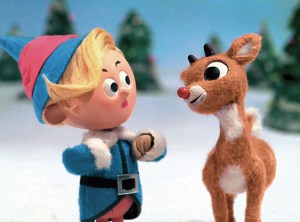
“Why am I such a misfit?”

4212433203_d4e6cb4f74_zOne of my favorite things about this time of year is some of the movies and Christmas specials that are on television.

There’s plenty of good, classic films to talk about, but last night I caught an annual can’t-miss, the 1960s Rankin Bass, “Rudolph the Red-Nosed Reindeer.”

I love the Rankin Bass stuff, whether it’s Rudolph, any of its sequels, Santa Claus is Coming to Town, or even Year Without a Santa Claus (I can often be found singing the Heat Miser/Snow Miser song around the house and out and about, much to the chagrin of my wife.)

One of the things that somehow went over my head as a child was just how mean some of those adults were to poor little Rudolph. Even his own father who tried his best to cover up what made his son different so that he could conform.

Not to mention, Santa Claus, who was a real jerk. From the way he reacted to Rudolph after his birth, to the way he speaks to Rudolph’s father, Donner, when Rudolph’s cover-up nose falls off and his real, red nose is exposed.

“Donner, I’m ashamed of you.”

Wow. Santa, you jolly old elf, are mad that Donner tried to have his son lead a normal life? Wow, I’m surprised the Mrs has stuck around as much as she has.

Nothing like making this poor kid feel even worse about the way he was born. No wonder he ran away from them all. Who would feel loved around that?

rudolph-RankinBass-Productions-Videocraft-InternationalAnd poor Hermie. He hates the job he’s in, yet is being told by everyone around him to conform to making toys even though he’s miserable. Why? Because it’s just the way it is.

At its heart, it’s a message about acceptance, of course and about pursuing your own sense of happiness, whether it be guiding a sleigh, pulling teeth, or whatever.

What a nice feeling inside when Rudolph, Hermie and Yukon Cornelius not only find a friendship founded in their mutual feeling of being outcasts, and the people of Christmas Town eventually realizing that different does not mean bad.

There is a sense of triumph for the little guy when Hermie gets to do something other than make toys and Rudolph gets to lead the sleigh on Christmas Eve.

All this was honestly lost on me as a kid, at least on the surface level. Now, as a father, especially, I look it at a bit differently.

Now when I watch it, I see how important it is to not only let your child now how all right it is to be different, but to encourage it. Be yourself, be different, embrace your individuality.

I hope that I can teach y son to know not to listen to the bullies around you, be they on the schoolyard, in the home, or in the workplace. You are who you are for a reason. You are special for that reason.

We are all different. If only we would all accept those differences, I think we could see what a beautiful place this world can be.

You drool on it, we buy it

ImageMy wife and I took our little guy with us for some Christmas shopping recently.

He, quite honestly, did terrific. Whether it was department stores, book stores, clothing stores, he was great the whole time. We even got to go to lunch in between without any fuss.

We wrapped up our night at our local Barnes and Noble, where my wife spotted a stuffed Gingerbread Man doll. She showed it to him, prompting a huge smile. The little guy reached out, grabbed the doll and hugged him tight.

Yes, it was cuteness overload.

Then, as any four month old might do, he let out a huge wad of drool all over the Gingerbread Man and then shoved the doll’s head into his mouth.

Thus, the origin of our private courtesy policy of “you drool on it, we buy it.”

Needless to say, The Gingerbread Man, now named Dougie, has since taken up residence with us.

Turning the pages of comics and time…

Sometimes repeating something from your past can make you realize just how much the future has changed.

This past weekend, I indulged my inner-dork and met up with some old friends to go to a comic convention about an hour side. It’s one of those occasional traditions that we’ve done since adolescence. Some things have changed – I find myself rarely buying anything at these shows anymore. It’s more about the camaraderie and hanging out with old friends again more than anything else. The car ride and lunch always tend to be the highlights these days more so than the actual comic events themselves.

This time was no different. I didn’t purchase anything, but we had a great lunch and some great laughs on the way up. On the way home, though, I found myself a bit reflective, thinking back to those trips over the years. More notably, I thought about how life used to be AFTER those trips over the years.

As I stared out the window, I thought about how, for so many years, those trips, while fun, would always end with my returning home to my empty apartment, setting any purchases I made down on the nightstand for later reading, and then, that was it. Don’t get me wrong, I appreciate solitude, but after a while, solitude can turn to emptiness.

Today, I have a wonderful wife, a happy little son, and a trio of wonderful cats (also my sons, only feline) to come home to – a shelter of love that instills me with a smile and joyous feeling the minute I walk into the door.

When I looked back on how life had been, I felt sad, touched by a sense of sadness that never quite resonated as much as when I my life felt so filled. There are moments in life that have the ability to be the turning point for change. They are all dependent on the choices we make at those moments. As I reflect back on the past, there will always be things I wish I had done differently, but the choices that led me down the path that would yield my wonderful family, I would never change.

There’s a lot of times when I get frustrated or upset about something – whether it’s the house, the neighborhood, things at work, money, etc. All of that, though, seems trivial, when I realize just how lucky I am to have as much as I do. In the day to day hustle and bustle, it can get very easy to focus on the negative or what APPEARS to be “missing.” .

I may not have indulged my inner-geek with purchases at the comic convention, but I indulged my inner peace by looking at the past, realizing how empty it would be had life not taken the path it had, and coming to the realization of just how fortunate I am for all I have.

Confessions of a List-Maker

Image
A typical day’s to-do list

I live by lists, I admit it.

Every day, my planner is filled with a myriad of “to-dos” that I set out to try and accomplish, be they personal, work, phone calls, writing projects, blog posts, catching up on e-mail replies, or just things around the house. There’s a great feeling of accomplishment to be had when you cross something off your list and know that it’s done and complete and you don’t have to worry about it again, unless it’s a recurring task.

It’s a habit I got into back in high school, around 10th or 11th grade. An assignment from one of our teachers was to go out and buy a planner. The type didn’t matter, as long as it worked for you. Then, for the rest of the year (and the following year if you had that teacher, Mr. Hanley, again), you were to keep track of all your appointments, schedules, assignments and more. The purpose was to help us become better organized individuals before college. I can’t speak for anyone else in the class, but it definitely ended up working for me, and quickly became a habit that I carried over into college and then onward to the rest of my life.

In fact, at this point each year, I find myself doing the annual purchase of a new planner for the upcoming year. You don’t need anything expensive. While I’ve seen planners that are in the double digits, I frequently find mine at any $1 store. Another year, another 365 days of lists, of projects, of things to do.

Suddenly, though, I find things are changing a bit.

Sure, I’m still writing out my lists the night before of what I want to get done the following day or in the days ahead. Yes, I’m still typically piling as much into those lists as possible, as I always seem to have way too many things on the burner to handle at once. What has changed, though, is how much gets crossed off them.

What, in years past, would equate to me burning the midnight oil and running myself ragged to accomplish every single thing on the list, has dwindled. The lists are the same, but usually I average only a few things, some days only one, on those lists. A lot has happened in those times between then and now. I’ve graduated college, I’ve been in the same career field for more than five years, I’ve gotten married, and we’ve had our son. All life changing experiences that come with their own built-in responsibilities.

So it shouldn’t have come as so much of a surprise to me when the “crossed off” items on my lists were becoming so few each day. Initially, it would make me annoyed, some times a little depressed. “How is it I used to accomplish so much and now feel that I accomplish so little?!” I would think to myself. I would even try to cram as much as possible into the weekends because so much time, between work and home life was eaten up during the weekdays and weeknights.

I used to think when a weekend concluded and I hadn’t crossed everything off my to-do list that time had been wasted. Now, though, I realize it’s just more time spent with my wife and son, and that’s never a waste of time.

You only live once. Don’t get caught up in the to-dos of a list that won’t stand the test of time when you can be investing in the greatest commodity you have, your loved ones.

Making ‘cents’ when it comes to education

I think every parent wants their child to have better opportunities than they were able to have, or afford. Just about anyone with a child wants their child to be able to have a better life than their own (and if they don’t, then maybe they should re-think this whole parent thing).

With that in mind, I’ve started the process of setting up a 529 account for our son so that when he becomes of age, there is money that has been invested and put aside to help him further his education. Of course, we’ll also be hoping and encouraging him to apply for scholarships and grants wherever they’re available.

Whoa whoa whoa. Slow down there, dorky daddy. Talking about college already when your son is only nine weeks old? What gives?

Here’s where it comes from. You see, while I went to college and received a degree, it was not a road easily traveled for me financially. Sure, I’m confident there are many who had things far, far worse when it came to affording higher education, don’t get me wrong.

However, financial aid and a grant only covered so much, and the rest (and there was a lot of ‘the rest’) was covered by student loans. What’s worse, the majority of them were private student loans, as public student loans only cover so much.

I would never want to give up the experiences and lifelong friendships that I made in my time away at college, but the costs that came along with it have become the gift that keeps on giving…to the banks.

At the young age of 17, 18, 19, I wasn’t thinking about what my life would be like 10-15 years down the road. It was all so ‘far away’ that I just naturally assumed and had confidence in the fact that I’d very easily get a job and pay off any loans that I took out to pay for college.

How young, foolish and wrong I was.

Even in the current journalism job that I’ve had for more than five years, I’m still paying out half of my paycheck each pay period to student loan lenders and will be for years to come.

So is it worth it anymore?

It used to be that people attended a college to learn more about a specialized field. Today it seems like it’s become nothing more than a “credential” that one needs in order to get a job.

So, we take out massive debt to get a piece of paper that may or may not help us get a job in order to pay for the massive debt we took out in the first place.

We’ve become indentured servants to our schooling and the banks, forcing us to stay in jobs that we might otherwise take the leap of faith out of to bigger things, but stay where we are for the security of knowing we can pay off that education debt that has outgrown so many other bills.

I don’t want that for my son.

Hopefully, by teaching him not only the importance of learning and how to learn, but investing in the 529, should he choose to go on to college, he will not become the Jacob Marley of education, wearing the shackles of student loan debt that so many of us on the college degree chain gang must wear.

The TIME in bathtime

Time is going by fast.

My wife is giving our son a bath as I write this.

It’s Sunday night, the temperature outside is a reminder that fall’s crisp breeze will be here anytime. Inside the house, the lights are low, there’s no TVs on, and the only sounds throughout our home, other than my tap tap tapping away at the keyboard, is the two of them. She has him in the kitchen sink, with a comfy yellow foam piece especially for baby’s bum underneath him, and he is quietly taking it all in as she cleans him up, singing to him alongside a Celtic Lullaby CD her sister gave us before he was born.

I can hear her voice throughout the house, despite its softness, but what I don’t hear is him. He’s not yelling, he’s not crying, he is simply getting clean and watching and listening to his mother in awe.

It’s quite heartwarming.

It also brought with it that moment in my gut after my brain realizes “I can’t believe you’re going to be a little person someday.” Sure, we’re only a little over eight weeks right now, but where did all THAT time go? I shudder to think how fast the next year and so on will drift by.

A reminder to savor every waking moment we can, for sure.

Hope you all had a great weekend.

What I’m Reading: Some magical quotes from “Magical Child”

I’m still reading Joseph Chilton Pearce’s “Magical Child.”

Rather than bore anyone with my attempts at a book review, I thought I’d share a slew of quotes and notes I found interesting amid the next few chapters.

Chapter 2 – Matrix Shift: Known to Unknown

“The womb offers three things to a newly forming life: a source of possibility, a source of energy to explore that possibility, and a safe place within which that exploration can take place.”

Once we have a an established bond in that matrix (the mother), a child is then ready and able to move on to to the next stage of development.

“The early child can move into an exploration of the world only by standing on the safe place provided by the mother. Later, after age seven, the child can move into the matrix of his/her own personal power only by standing on the safe place of the earth itself.”

In order to relate creatively and explore all possibilities, one has to achieve independence from the matrix. To relate fully to the mother, an infant has to leave the womb and eventually, move on from the dependency relation with the mother. After age 7, to relate fully with the world, the child must functionally separate form the world.

“Intent always precedes the ability to do; that is, during any particular stage of development, nature is preparing us for the next stage.”

“Everything is only preparatory to something else that is in formation, as day must fade to night and night to day.”

“We can force certain forms of abstraction prematurely on the child in his/her concrete stage of development, but the effects are specifically damaging (even though the damage will not be detectable for several years).

“…the newborn infant requires about eight or nine months to structure a knowledge of the mother as new matrix and move out to explore the larger matrix, earth; the child requires about seven years to structure a knowledge of the earth matrix and shift from mother as safe space to earth itself; and so on.”

If you are stressed, the baby will be stressed.

Interaction is a dynamic interchange of energy. Interaction automatically increases and enhances our safe place.

“Give the safe place for growth, the vast possibilities of the huge womb world, and the great energies of the mother’s body to call on, that tiny organism grows at an astonishing rate.”

“This interaction is the growth of intelligence and body and is the pattern our entire life should follow.”

“Research shows that the mother is the infant-child’s basis for exploration of the world itself.”

“The mother is the infant’s world…she is the infant’s power, possibility, and safe place.”

In those first eight to ten months of life, the baby has to, above all, structure a knowledge of the mother.

“Only when the infant knows that the mother matrix will not abandon him/her can that infant move into childhood with confidence and power.”

“Development then moves toward structuring a knowledge of personal power in interacting with that world matrix.”

“The biological plan is wrecked when the intent of nature is met, not with appropriate content, but with the intentions of an anxiety-driven parent and culture.”

“Anxiety results when the child is forced in mismatched relating of intent and content. Interchange with the matrix and growth of personal power then break down, but the sequential unfolding of maturation goes right ahead.”

“We must first recognize that such a plan exists…We knew about this plan when we were around six years old and a great excitement, longing, and joyful anticipation filled us. Something else happened, of course; and even as it happened, we know intuitively that it was all wrong. This primary knowing got covered up by anxiety conditioning, which was so deep and pervasive, so ingrained and so continually reinforced and amplified on every hadn that the deep knowing has been lost to us.”

“We must rekindle our knowing of a personal power that can flow with the power of all things and never be exhausted.”
Chapter 3 – Intelligence and Interaction

“Interaction is a two-way exchange of energy, with an amplification of the energy of each of the two forces.”

“Reaction is a one-way movement.”

“We always tire when energy flows out in this way. In true interaction, however, we never tire.”

“Through interaction, intelligence grows in its ability to interact. We are designed to grow and be strengthened by every event, no matter how mundane or awesome. The flow of nature and seasons, people, extreme contrasts, apparent catastrophes, pleasantries — all are experiences of interaction to be enjoyed and opportunities for learning, leading to greater ability to interact.”

“Any bodily involvement by the early child brings about a patterning in his/her brain system concerning that movement and all the sensory information related to it.”

“If repeated sufficiently…puppetlike movements…will lead to that infant’s ability to initiate and complete these movements months ahead of an infant who is not so stimulated.”

“Intelligence can only grow by moving from that which is known into that which is not yet known, from the predictable into the unpredictable.”

“When people express reaction-aggression, they are expressing not just a crippled intelligence, but what they have actually learned.”

“Growth of the infant-child’s ability to interact means increased rhythmic patterning in the brain and corresponding muscular responses. This growth can be slowed almost to a standstill by subjecting the growing child to demands inappropriate to his/her stage of development, that is, by trying to to force the child to learn or deal with information or experience suitable to a later stage of development or by keeping them locked into an earlier stage. Then the child learns that learning itself is difficult and frustrating or non-rewarding.”

“…adult idea systems and opinions, is designed for the later years for development. Forcing the early child to deal prematurely with adult abstract thought can cripple the child’s ability to think abstractly later on.”

“Direct physical contact with the world – taste, touch, even smell – are often either discouraged or actually forbidden in the parent’s anxiety over the hazards of germs and imagined threats. Without a full-dimensional world view structured in the formative years…no knowledge of physical survival can develop.”
Chapter 4 – stress and learning

“When we know the probable outcome of an event taking place around us, our body systems can remain fairly passive and relaxed.”

“We spend large part of our adult lives establishing routines that allow us to function with a minimum of sensory sampling.”

“The unknown-unpredictable imposes sensory data that do not fit the brain’s established editorial policies well enough to be handled automatically by various subordinates.”

“To enter into an unpredictable situation and accept it openly is to flow with its energy, be augmented in your own energy, and relax its tensions and stresses accordingly.”

“The periods of prenatal life, delivery, birth, and infancy are all genetically designed to provide exactly the kinds of experience needed for the brain to structure its place of power.”

“The mother is the infant’s first matrix and the source of his/her possibility.”

“If this matrix does not become fully structured, if such a security and strength are not given from birth, intelligence will have no ground on which to grow.”

“Without that safe place to stand, no energy can be utilized to explore possibility…”

“We then spend our lives trying to avoid this threat. (the unknown)”

“The person denied the first matrix remains grounded in that earliest stage, trying to establish some arbitrary and artificial safe place of his/her own making. It is a compensation that never works.”

Dry-erasing the memories as a new chapter starts

It’s been an emotional 24 hours, and it all begins with a dry erase board.

What? A dry erase board? How much wallop can a piece of plastic sitting on the refrigerator really pack?

Quite a bit, actually.

You see, the dry erase board has been hanging on our fridge from the day we first moved into our home (our first home, I add). As the past three years have ticked by, nothing was erased from it, only added to it. It began with my wife’s adorable drawing of our house right after the purchase, and the phrase “our house” above it, a nod to the song that makes us think of that day we finally closed on our little starter home, often prompting a “remember that” hug. Then came some messages back and forth leading up to our wedding day – an I love you here, an I love you too, there. Messages from visitors. Even some doodles of our three kitties that have expanded our family over the those three quick years (and are the reasons I discovered my paternal side and just how ready I was to be a dad).

This weekend, though, those memories went from the dry erase board that we passed every day, to memories for life in our heads as we erased to make way for a new chapter.

That chapter, of course, is the life with our newborn son. He’s 7 weeks old now, and today marked the first day my wife had to return to work and that dry erase board now serves as the list of reminders for our new morning routine.

I’ve written previously about my fears leading up to this, but today was it.

Due to a number of factors, including the challenges that have come about with breastfeeding, as well as some economic restraints, we’ve taken a member of the family up on an offer to watch him during the day while we’re at work. While this strikes our wallets much easier, it still has not made the emotional punch of separating him from mom any softer.

Yesterday was filled with that anxiety of what’s to come, every routine movement filled with so much more sentiment knowing a pivotal point is about to begin. From his bath to his evening feeding, everything was filled with a tinge of sadness, knowing that tomorrow and the days forward would be different.

This morning, our new routine began, waking several hours earlier, getting ready, and most Earth-rocking, getting him ready. As we fitted him into his carrier for a trip in the car, it was hard not to fight back the tears that followed. He is our baby, our little man, who has spent these past seven weeks with his mommy at every moment.

We would love more than anything for my wife to be able to stay home with the kids, but financially, it is just not possible. We’ve tried every equation to find some way to make it feasible and the numbers just never add up. The front door closed as I carried him down the steps, my wife’s tear-filled face behind it.

It was the hardest thing emotionally I’ve ever had to do. I can’t imagine what it feels like the first time a parent puts their kid on the bus for school.

Being Sick

You don’t usually think too much about being sick other than the “ugh” feeling that comes along with it during the entire ordeal – until you have a kid.

For the first time in these past six weeks since he was born, sickness has hit the household, and it’s not just me. Within the past 48 hours, both my wife and I suddenly started coming down with something affecting out throat, chest, nose, and head. Being sick can be bad enough, but fighting back the gunk falling into the back of your throat, the burning sensation in your eyes, and having the baby screaming at the top of his lungs?

This is all new territory for us, my friends.

Last night, our dinner was a bowl of chicken soup, with hot tea (echinacea tea for me), and some hot lemonade for dessert.

Naturally, we’ve been incredibly concerned about possibly spreading it to our little one, and this morning, wondered if we already had. He screamed for well over an hour, and nothing could console him – not the melodies of Simon and Garfunkel, not food, not rocking, not snuggling, nothing. Imagine how scared we were to hold him close, too, considering our fears about spreading whatever sickness we’re carrying at the moment.

So, we called our pediatrician and expressed our concerns – especially his resistance to eating, whether it be breast or bottle.

He’s not running a temperature, which was a good sign, and they recommended running a cold mist humidifier, along with saline drops in his nose (to then be pulled out with a bulb syringe) to clear out his head. They said it could be that if he IS sick, that he could be stuffed up in his nose, making his mouth the only way he could be breathing. That means when he tries to eat, he is possibly blocking off his only way to breath, which could be why it’s been so hard to get him to take breast or bottle.

So, we’re going to see how things go in the day(s) ahead. I feel guilty that while I’m at work, she’s at home, dealing with a fussy baby who’s eating schedule is hit and miss while at the same time fighting off illness herself.

Any suggestions on keeping a six-week old from catching what mommy and daddy have?

The case of the pilfered pacifiers

We have had to do a lot of sterilizing lately.

No one is sick, but we have what you may call a “binky bandit” on the loose in our home. Binky being what we sometimes refer to our little one’s pacifier as.

At first, as we would reach for a pacifier and find it missing, my wife and I thought we might be losing our minds, finding them in odd spots throughout the house. Did we drop them, we would wonder?

Needless to say, we wouldn’t go popping them back in the baby’s mouth, and they’d instead get tossed into the “sterilization” pile for the next time we’d boil a pot of water containing pacifiers, bottles, nipples and the like.

Still, the mystery still waged on – short of growing legs themselves, what was happening to all these pacifiers. Was I sleepwalking? Egads, was the baby sleepwalking? If so, when did he learn to walk in these past five weeks?!

However, one morning, I awoke to hear some weird noises, like something being pulled across the floor. I followed the sound into the baby’s room, where I found, not our human baby, but our feline baby, Winston, looking up at me, with the pacifier in his mouth as if he were Maggie Simpson.

Now, I was unfortunately not quick enough with my camera to grab a photo of this bizarre sight. I wish I was, as I can not imagine how anyone would believe it otherwise. So you’ll have to settle for this “not as cool or funny” one from some time later.

There it was, though, our little gray guy – definitely the “baby” of our trio of felines, looking up at me as though this was perfectly natural for him to have a pacifier in his mouth like a baby.

Into the sterilization pile it went.