 If you know me, or heck, if you’ve read past entries on this blog, you know how nostalgic I can get – longing for previous times, or pieces of culture from various parts of my life, or even before my time. I admittedly get that way about a lot of things – cartoons, films, video games, comic books, and TV shows.
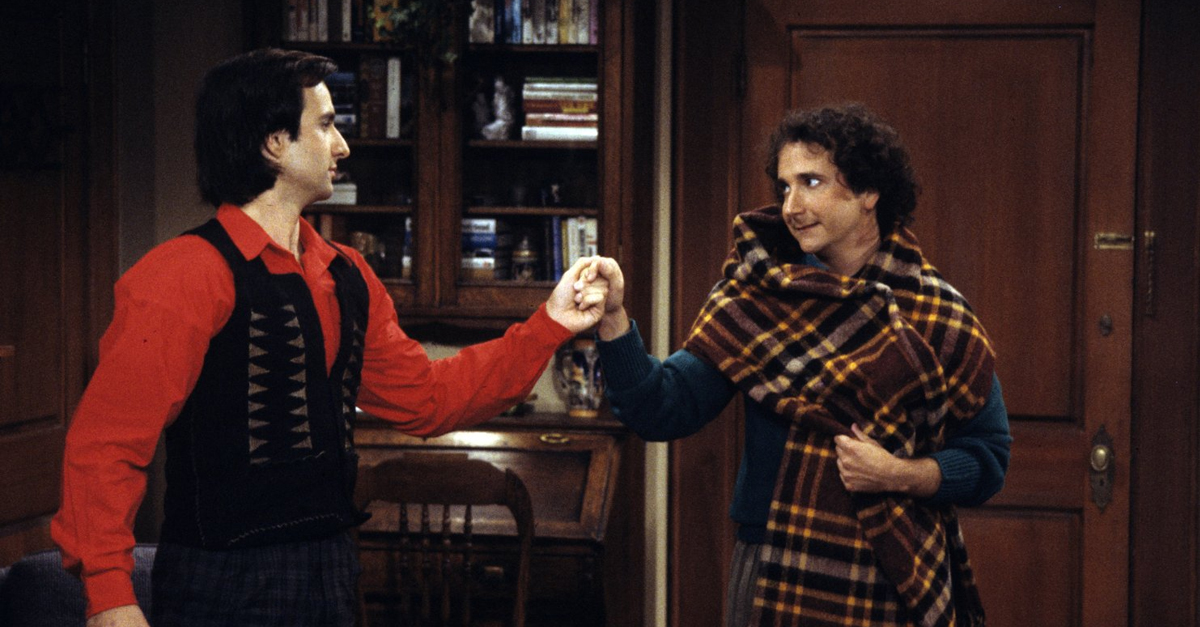
One of the TV shows that has constantly beckoned with a nostalgic siren’s call to me has been the misadventures of an immigrant and his tightly-wound distant relative trying to integrate into each other’s lives in 1980s Chicago.
For those of you who may be unfamiliar, Perfect Strangers was an ABC sitcom that ran from 1986-1983 and was about a kind, wide-eyed man from a tiny Mediterranean island (the fictional Mypos) named Balki Bartokomous who came to America with his childlike innocence and wonder and found a far-distant cousin in Chicago – the uptight, jaded Larry Appleton. The Odd Couple-esque set up allowed for many comedic, fish out of water situations as Balki tries to acclimate to America (while embracing its culture to the hilt), while helping his Cousin Larry make it through life without his many neuroses doing him in.
It also had one of the most uplifting, 80s-esque theme songs of all time, which also in 90 seconds set up the show’s premise before an episode would even begin.
I hadn’t seen the show since it was originally on the air but in the past year or so began watching again thanks to the interwebs and the myriad of resources to find just about anything we remember from our past. I can’t even recall what brought me to rediscover it. Likely, it was a passing reference on social media that made me suddenly start remembering catching the show as part of the ABC TGIF lineup of family-friendly sitcoms “back in the day.” Upon some re-viewing, I still enjoy it.
For a show that itself is often remembered as a piece of pop culture, it had many references to already-existing pop culture at the time, through Balki’s overjoyed discoveries of Western pop culture. Balki was often singing songs from the radio’s top 40 of the day, or relishing in something as simple as cartoon character merchandising.
The show is filled with pop culture references of the day, the situations are often based in many of the classic comedic tropes throughout sitcom history or even as far back as vaudeville routines, but there is something about the madcap hijinks or the charming camaraderie of these two oddball characters and the performers bringing them to life.
Beyond that, though, I feel there’s a bit more to my nostalgic attachment on a more subconscious level.
For me, it’s somewhat of a touchstone/an association with the decade that I grew up in – the 1980s. Now hang with me as I’m going to get a little autoethnographic on you. What’s ethnographic? Good question. I only recently learned myself, but according to Carolyn Ellis, Tony E. Adams, and Arthur P. Bochner, “when researchers do autoethnography, they retrospectively and selectively write about epiphanies that stem from, or are made possible by, being part of a culture and/or by possessing a particular cultural identity.”
I’m speaking as part of that culture, as someone who was born in 1980 and whose most influential and cherished years are from that decade and the 90s.
The 1980s. Pre-internet. Cassette tapes. No cell phones, no constant connections. From where I stand now with the day-to-day stress of having to constantly be available, rapidly respond, always connected to something, it all can seem pretty quieter. A nicer time, perhaps greater or simpler, even when awash in the neon glow of yuppies and mass-consumerism and excess that is often associated with the decade today.
But it wasn’t simpler. Or nicer. Or greater. At least not in a larger view with a wider perspective.
We were still in the midst of The Cold War. When I was in first and second grade at Seymour School, I remember us still undergoing the drills you see made fun of these days – crouching under a desk or going to the fallout shelter in the school’s basement in preparation for a catastrophic event.

A conversation with my mom about that time has led to remarks about the state of the economy, the cost of milk, and other anxieties that as a young parent were not as enjoyable as the carefree time that I so often subconsciously associated with the 1980s, and thus the media I consumed in that time, like Perfect Strangers.
Why is that?
Much of it comes because my recollections are shaded in rose-colored glasses because I was a child then. No need to go to work every day. No need to pay bills, to be responsible for others. My biggest responsibilities were to get up and go to school every morning, do my homework, and clean up after myself. Aside from that, what did I have to worry about, really? If i was going to play with Ninja Turtles, Legos, or super hero figures? If I’d catch Batman with Adam West and Burt Ward on WPIX or play a while longer and just watch Ducktales on Fox?
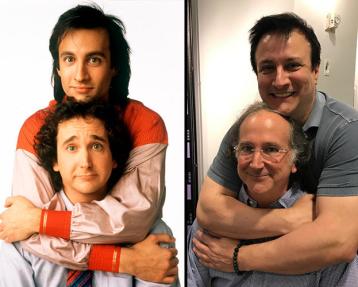
My point is that we are so prone to looking back at things and associating them with “the good times,” that our minds become clouded to the circumstances that made us think that way in the first place. Thus, the things we consumed or remember from those times become associated in our minds with the corresponding times we were exposed to them.
But those good times – they’re always going to look good when we take out the context of life in those moments. It’s why so many people look back on the 1950s as the perfect time, not because of the fear of atomic obliteration that came following Hiroshima. Not because of the domestic violence that bubbled quietly underneath the surface of smiling, surface-level-perfect families, or the loneliness and isolation that haunted those groups who didn’t work out of the house because of cultural norms. No, they were good times to those who were children at the time, living life with a more innocent view of the world around them, sans responsibility that would come later in life.
Perfect Strangers, through no action of its own, does just that. It opens a door inside my mind and memories to a period of life that seemed much more innocent, because at the time I first enjoyed it, I was.
And while it hasn’t yet found itself amid the string of rebooted/continuing sitcoms in the age of Netflix, Hulu and Amazon Video like shows such as Full House/Fuller House has, the entire concept does make me think forward to what shows/media my own kids will look back on wistfully decades from now when they reflect upon “the simpler times.” Will it be new shows originating during their childhood like Odd Squad, Wild Kratts or Ready, Jet Go? Or will it be shows that pre-dated their existence that were introduced to them from my generation and handed down (whether in original form or rebooted) in their childhood – like Inspector Gadget or DuckTales?
As Dr. Ryan Lizardi, author of Nostalgic Generations and Media: Perception of Time and Available Meaning puts it, “As older generations of people are encouraged to revisit media and products they loved as children by hyper-nostalgic media companies, through remakes, reimaginings, and re-releases, it leads to a reduction in available meanings for current and subsequent generations who are then all encouraged to attach to the same nostalgia-soaked objects…the cultural rise in nostalgic media has the dual generational impact of making the subjective experience of time speed up for those who are nostalgic, as well as create a surrogate nostalgic identity for younger generations by continually feeding them the content of their elders.”
Perhaps only time (and they, and the media culture existing as they grow) will tell.

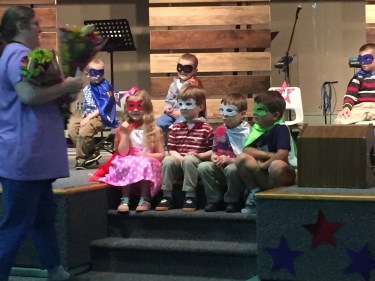 Like a breeze it arrived, swift and sweeping (in emotion).
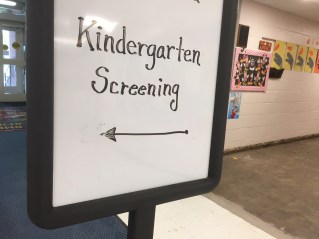 Added to that, his young world and expectations were thrown for a loop when we told him the weekend following his moving-up ceremony that he would be attending a different school than the one we were planning, the one he had attended multiple orientation nights for, where several of his friends from Pre-k were headed.
 So change is not always the adaptable, easygoing “get over it” that so many folks think is a default for all kids. It will take time. Time, time, time. You are a tricky thing. Filled with good, filled with bad, but most of all, filled with change that keeps our worlds from ever getting boring, and teaching us to learn as we go and figure out how to change with you (even if it takes some of us a little longer to accept) at the risk of being left behind.
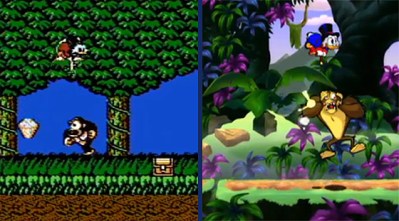
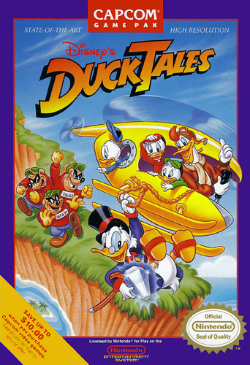 I’m not really a video game guy.


 In the course of any given day, I check my smart phone device constantly, scrolling through Twitter and thinking if I have anything funny to say, checking email to see if anyone’s gotten back to me about the house we’re selling or one of the myriad of book queries I’ve put out there, checking in with the virtual beings whose lives I lord over in Sims Freeplay, or checking my Google Keep app for the numerous to-do lists it allows me to make, organize, add to, and check off as I complete things in the never-ending, always growing list of tasks for work, home, creative pursuits, etc. It’s constantly ongoing, and I keep it that way. I constantly think of things that need to get done and add it to the list. Or I check to see what i can cross off. Some are more pressing than others. Others aren’t necessary at all. But I check obsessively regardless. It’s as fruitless as trying to keep up with email.
 Then I think of the calm, the peace, the feeling of being in the now, in the present that I felt looking at the baby’s form on that monitor. It may sound silly, but it was almost akin to the feeling of being present I experience when I’m sitting alone looking at nature, whether it’s a walk through a nature trail and admiring the plants and trees, or sitting quietly in our backyard, sans digital devices, getting lost in the greenery, trees, squirrels, rabbits, birds, and wildlife going about their day.
 “…but the Riddler’s clue, Robin. When is a door not a door?”
 We’ve been making a lot of trips recently to what will soon be our son’s new elementary school for a series of Kindergarten nights designed to get the kids used to the environment, to the lessons (lots of tactile activities, games tied into words, letters, etc), and getting to know their soon to be teachers and classmates.
 There, in the bathroom, were of course the sinks, the standard toilets, etc. But then, as if rays of sunlight poured out of it, was a stall with a urinal. Yes. A urinal within a stall, with a door that closed. And if you’ve ever been in a public bathroom with your son, standing at a urinal with his pants around his ankles and his bum sticking out for the world to see, you’ll understand why I thought this was such a cool concept.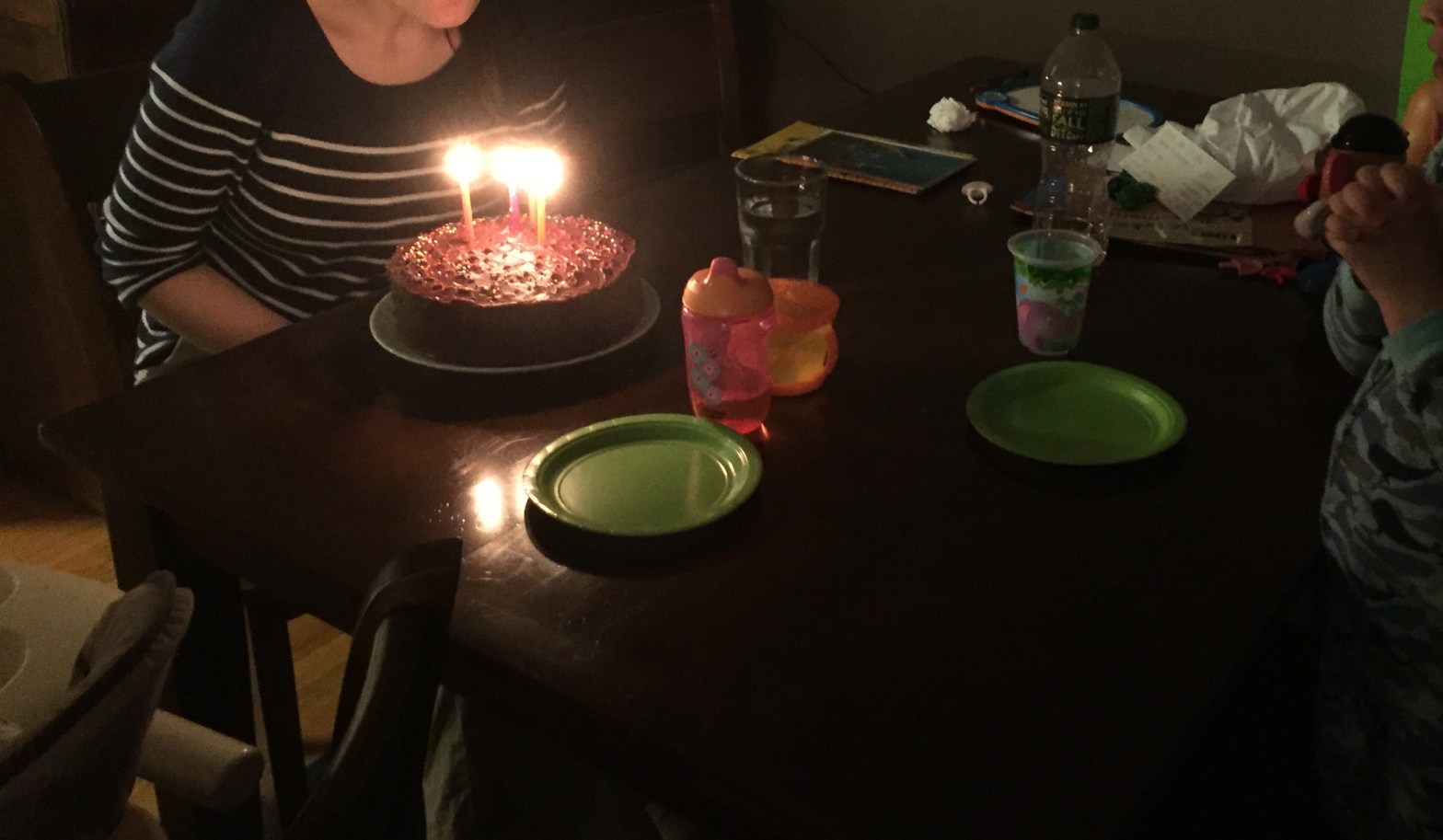
 It’s been a big week in our household.
 The kids were excited to unveil their gifts, which they picked out themselves – a scarf, an adult coloring book (“To calm you,” the little guy told her) and a book on Thomas Jefferson (“Because I know you like history, and books, and Thomas Jefferson’s your favorite president,” he explained) and a copy of Mike Nesmith’s new autobiography and the accompanying CD from me.

 It’s no big secret that I’m

 It was just one of those nights. No matter what hour the clock ticked away to, it all played out like a CD that wouldn’t stop skipping – the crying from our daughter’s room going on and on as the night stretched to early morning.
 Anywhere and everywhere along the open road was the map of our journey, through the streets of downtown, to the country routes of neighboring villages and towns.
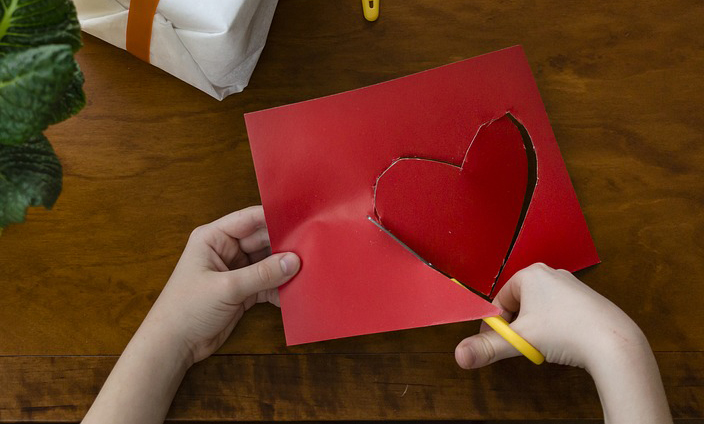
 This past Valentine’s Day, our son and daughter each got cards in the mail from their grandparents. Inside our son’s card was a ten dollar bill. He immediately became very excited, with a wide smile and look of excitement on his face. I imagined that images of a new action figure or some type of toy was dancing through his head.
 But here, faced with the reality of cash in his hand, he wanted to give it away, to help someone less fortunate than he and it meant the absolute world to see.
 According to Tomasello, human beings have a sense of “we,” a shared purpose, a bond that he says explains even simple social norms such as what makes it rude to walk away from an activity with another person without any type of advance warning.
 “Today you are you. That is truer than true. There is no one alive more youer than you.”
 Whether it’s Horton in Horton Hears a Who, trying to save the Whos that are on the head of the flower despite the other creatures of the jungle making life downright miserable and tortuous for him, the Sneetches learning that just because some have stars on their bellies and some do not does not mean that they’re truly any different from each other and can get along, or the importance of opening our eyes to what is around us and seeking out knowledge to better understand people, places and our shared world in I Can Read with My Eyes Shut, it’s all about learning to better understand each other.
 One of the running gags between my son and I are to suddenly take our conversations into rhyming territory, going back and forth, sometimes to a point where he ends up making up his own Seussian type words just to keep the rhyme going.
 “The words that he made up were often funny, and it helps children with their literacy skills later on as they’re learning to read if they’ve heard how language can be played with,” Neely also told Live Science.
 The Dorky Daddy