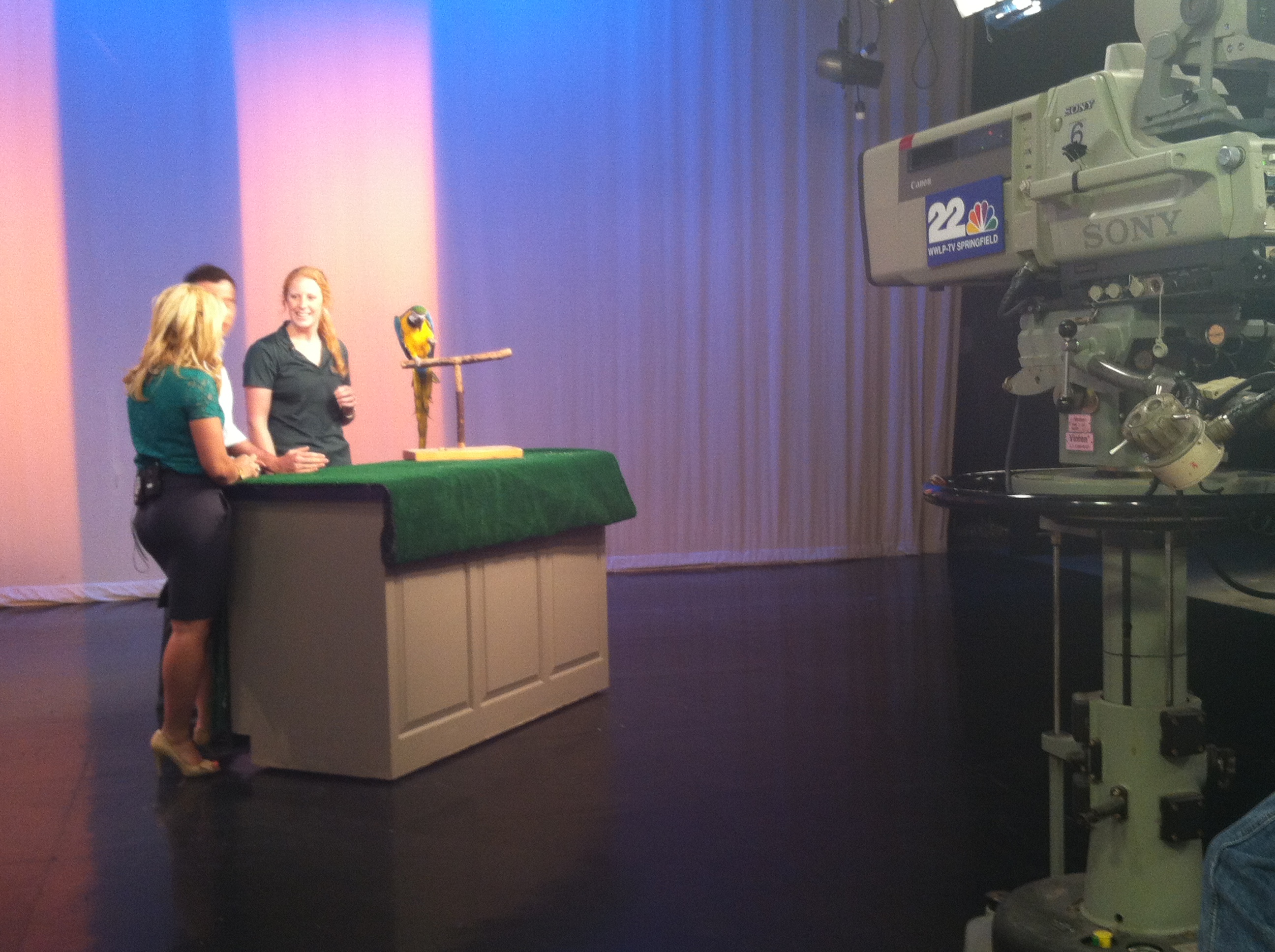
Coinciding with my recent post about great children’s books that will keep adults entertained at story-time, I was lucky enough to be invited back recently to the mid-morning Lifestyle program, Mass Appeal to talk briefly about those books and the authors who make them so much fun for both parents and kids.
You’re gonna’ trust this guy with books?!
We had a spot of trouble getting there, as we got on the thruway only to have the check-engine light come on for my car. With my wife’s car having its own trouble at the time, we had to get off the thruway at the next available exit, turn around, and borrow my mother-in-law’s car before getting back on the thruway. It added an extra 45 minutes of time to our trip and I’ll be honest, I didn’t think we were going to make it in time for the segment.
Fortunately, all went well and we made it with plenty of time to spare and nothing owed to a lead foot. I apparently managed to make it without breaking speed limits or rules of the road.
The even greater news? For both the trip there and back, our little guy did phenomenal with the travel. Even when he wasn’t napping, he kept himself entertained with books, toys, or just chattering with us about some of his favorite words.
I really had a ball and where else can I say that my fellow guests included a baby alligator and a parrot?!
We not only talked about the books but I also got the chance to play quasi-game show host and quiz the program hosts, Ashley and Seth on some ‘dorky pop-culture trivia.’ I even pulled a jacket from an old Halloween costume (The Riddler) out of mothballs to wear on air for it.
It was a lot of fun and though our time in the area was limited, we did squeak in a brief reunion with some old friends and THEIR little one, who I’m relieved to say, at nine months old, did not seem frightened by our little guy’s Frankenstein-like onslaught of hugs.
I know that these days, many people associate Memorial Day as ‘the unofficial start to summer’ or a ‘long weekend’ to barbecue, travel or get together with family and friends.
None of those are inaccurate ways to spend the day. Heck, we took advantage of nice weather and worked on our garden. Just make sure while we enjoy having fun with loved ones, to take a moment and remember those who helped make it possible for us to do that. Those who have fought, who have passed and who have fallen.
Regardless of your politics, leanings or beliefs, it’s not a day about sides. It’s about people. People who put everything on the line and in some cases gave it all, for others. It’s a time to say thank you and to remember that.
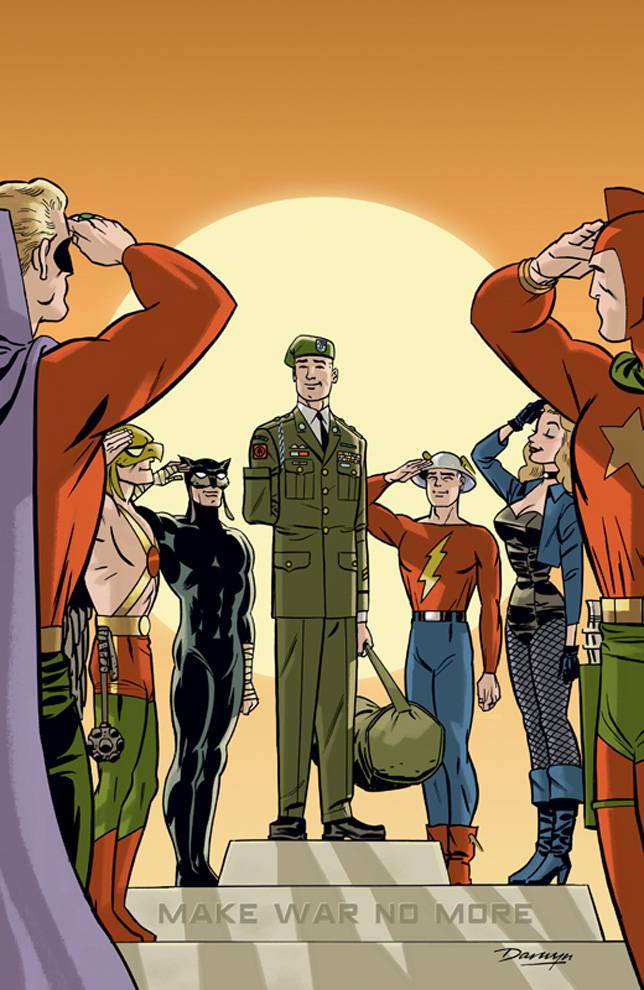
I’ve often talked about my fascination with the WWII era, as well as my love of pop culture and comics from that time period. I can’t think of a more suitable depiction for a blog called The Dorky Daddy to symbolize it than with this piece by one of my favorite artists, Darwyn Cooke, and the 1940-era super-hero team The Justice Society, saluting a true hero.
Not our actual bookshelf, but boy, doesn’t it look pretty?
Storytime is a wonderful and strong tradition to have in your household, and the earlier you start with your kids the better.
We’ve made storytime a nightly habit in our house, starting the week our little guy came home from the hospital. Now almost two, it has become routine for him to go to the bookshelf, grab a few books he wants and then bring them into our room for a family reading on the big bed.
Needless to say in that time, we’ve amassed more than a few that not only he likes, but my wife and I love to read as well.
As much as I often get nostalgic and wish for ‘simpler times’ or the always-idealized ‘old days,’ one of the great things about the current age we live in is that children’s books have come a long way from “Goodnight, Moon,” which, let’s be honest, is not one of my favorites.
These days, children’s books can be just as enjoyable for parents to read as the kids, so these are just a few suggestions that entertain parents as well as the kids that you might want to add to your family bookshelf if you haven’t already.
“The Very Hungry Caterpillar” & “The Grouchy Ladybug” by Eric Carle
It’s the 45th anniversary of “The Very Hungry Caterpillar” this year and this book helps to teach days of the week and successive numbers through the timeline of a caterpillar’s metamorphosis into a butterfly. It’s one of those classics that is just educational, fun, and absolutely beautiful, as are all of Carle’s books.
“The Grouchy Ladybug,” as her name states, is a bad-tempered bug that doesn’t say please, doesn’t say thank you, and has quite the ego, thinking she’s better than everyone she encounters. The story follows her journey and teaches about concepts like size, time and, of course, good manners.
If you end up really loving Eric Carle’s books (and how can you not?), take a road trip to Amherst, MA to visit the wonderful Eric Carle Museum right over in Amherst. You’ll find his original artwork, as well as get to view the work of guest illustrators on exhibit firsthand. This place is like a mecca for our family.
Books by Mo Willems
Mo Willems is a writer and animator and worked on Sesame Street for several years, where he won Emmy Awards, as well as shows on Cartoon Network. He has written so many wonderful books, but these are some of my favorites.
The Elephant and Piggie series – Gerald the Elephant (named after his favorite singer, Ella Fitzgerald) and Piggie are best friends and through these books deal with issues of friendship. Sometimes it’s separation anxiety, other times it’s being nervous about getting invited to a party, or sharing a new toy or ice cream. It’s all done in a conversational, comic book type style with word balloons and they’re just a lot of fun, each with its own great, positive message.
The Pigeon books – They star, obviously, The Pigeon, who usually wants something. Sometimes it’s to stay up late, or to get a puppy, or to drive the bus, and it’s always something he’s not supposed to do, giving the child, who oftentimes is being told “no,” the opportunity and power to say no themselves. These are highly interactive, so kids love them and parents can enjoy the humor, too.
That is Not a Good Idea – It’s done in a style of silent films, with a great twist ending and deals with just what the title says – not so good ideas.
How do Dinosaurs Take Care of their Cats by Jane Yolen
This book asks the question “How Do Dinosaurs Love Their Cats” and it’s just one of a wonderful series by Jane Yolen. Each book teaches manners and the proper way to act in different situation, this one, of course being if you have cats at home and the proper ways to treat them. There’s books for dogs, parties, playing with friends, cleaning your room; this goes on and on. Great lessons and great images by Mark Teague with a dinosaur name hidden on each page. Many of these types of dinosaurs are well beyond the common ones we come to know, which provides an additional educational element.
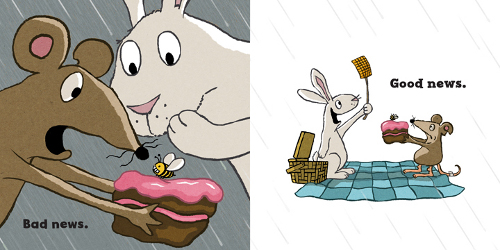
Good News Bad News by Jeff Mack
It’s about two friends with very different views on life – one optimistic and one not so much. When children are emergent and anxious to start reading, this is a great book. There’s only 5 total words in it. Those words are repeated, so they learn them better and can eventually read on their own. And the story itself is just funny and touching, and shows why it’s nice to look on the bright side of life.
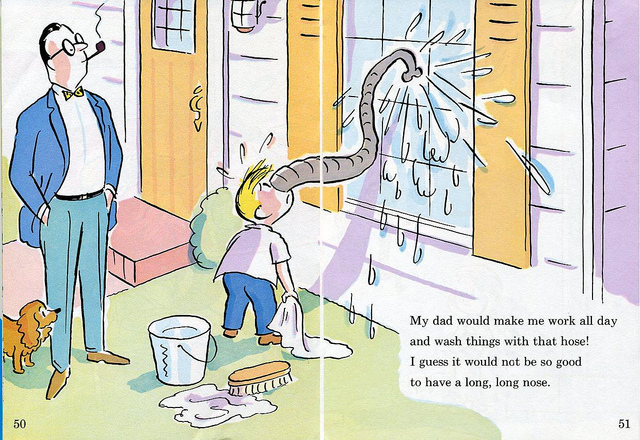
I Wish That I had Duck Feet and Gerald McBoing Boing by Dr. Seuss
Sure, there are more popular or well-known books by Dr. Seuss, but these are two that really have great lessons. Both are about being yourself.
In “I Wish That I Had Duck Feet,” a little boy daydreams about what it would be like to have different animal parts but realizes the downside of each.
In “Gerald McBoing Boing,” a little boy named Gerald can’t speak but is born with the ability to make incredible sounds when he opens his mouth. He gets made fun of by others for his difference, being called Gerald McBoing Boing by bullies, but it’s about Gerald finding his place in the world and being happy with who he is that ultimately finds him happiness.
Click, Clack, Moo – Cows That Type by Doreen Cronin
Cronin writes these to be entertaining and hilarious, and this book details the trouble of poor Farmer Brown as the animals in his barn begin to type and start becoming literate.
When that happens, they have more bargaining and leveraging power with the farmer when he demands things like milk, eggs, etc. It’s a great book that really teaches about give and take and even peaceful protest.
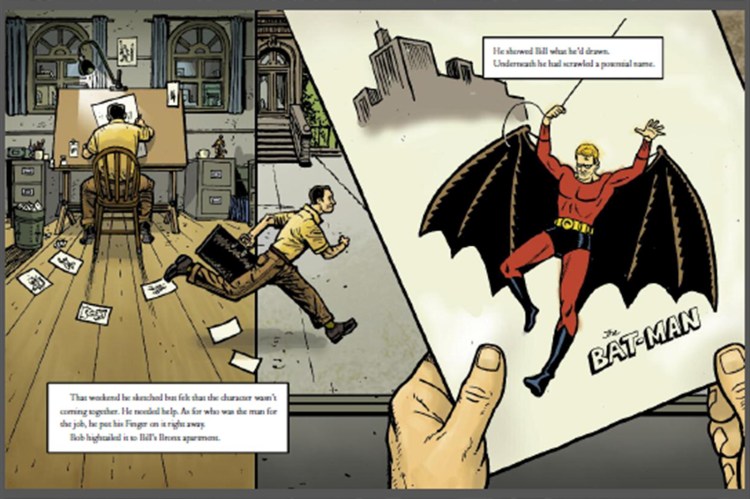
Bill the Boy Wonder by Marc Tyler Nobleman
The kids will get sucked in by the beautiful art and images of Batman and Robin by artist Ty Templeton, but the well-researched story by Nobleman tells the real-life story of Bill Finger, the man who created most of Batman’s villains, decided he should wear a cowl and gloves. It was his ideas that Batman what we know today and sadly didn’t get the credit for it. A great true story told in the form of a children’s book.
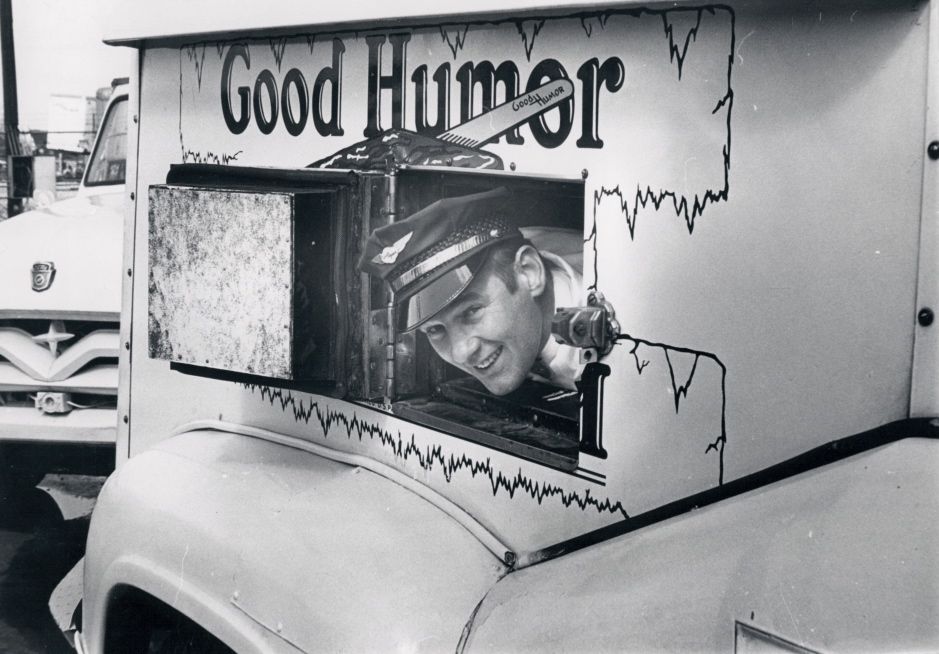
There is just something inherently creepy these days about the Ice Cream Truck coming down the street.
If you’re an ice cream truck driver, I apologize. It’s very likely not you. Or at least, I hope it’s not you.
Oh, I’m sure that back in the day it was an innocent and smile-inducing moment to see that white truck making its way through the neighborhood, music and bells ringing through the air. Heck, even I remember just two and a half decades ago, how normal it seemed to have the ice cream man come down the street and eagerly await to get some cold treats in the summer.
Through a little internet searching, here’s some background on the ice cream truck, or ice cream van as it’s sometimes known.
Early ice cream vans carried simple ice cream, during a time when most families did not own a freezer. As freezers became more commonplace, ice cream vans moved towards selling novelty ice cream items, such as bars and popsicles. Early vans used relatively primitive techniques: their refrigeration was ensured by large blocks of dry ice so the engine was always turned off when the van was stopped for sales. The chimes were operated by a hand driven crank or a take-off from the engine, so they were not heard as often. Modern chimes are always electrically operated and amplified.
I know it’s too much to ask for it all to still seem like this, but…
There are different types of ice cream trucks currently in use in the United States, some simply novelty trucks and some are soft-serve trucks.
Professionally built ice cream trucks that sell prepackaged product (Novelty Trucks) use commercial cold plate freezers that plug in overnight and when unplugged maintain the cold for at least 12 hours. Music systems are mechanical, such as pianos, or more commonly digital devices that have no tape or other moving parts. Each “music box” may be able to play one or multiple tunes. The opening on the side that drivers serve from is commonly referred to as a serving window and will usually have a serving counter. Awnings can be attached to trucks over the serving window. Safety equipment usually comes in the form of an electric or vacuum swing out sign which may resemble a stop sign or a triangular shape, as well as vinyl lettering or decals that advise others to use caution.
These are the only types of ice cream trucks that I’m familiar with in my own youth, cruising up and down the street, making me bug my parents or grandparents to buy me a Pink Panther ice cream on a stick, shaped like his head, with pink and white ice cream, and bubble gum for eyes.
Soft-serve ice cream trucks are actually a whole foreign concept to me. Instead of the pre-packaged ice creams, they actually have soft-serve machines in them and can offer you cones and sundaes. Honestly, I think I would’ve liked this a lot better than the pre-packaged stuff. They aren’t seen very often in the U.S. because of the extra costs with building such a truck. Oh, U.S. – cheap, cheaper and cheapest. Aesthetics and quality never really come into play here, do they? It’s a shame.
Maybe because of that desire to keep costs low, those ice cream trucks don’t always hold up well over time, which certainly doesn’t help deter the creepy factor I now see as an adult, the run-down rusty-looking truck barreling down our street at speeds quite unsafe for children who may be running out into the street to follow.
Or perhaps it’s the Dateline culture we live in these days, the numerous kidnapping stories splashed across the headlines, the horror movies made on the subject. As an adult, I just raise a skeptical eyebrow when I hear the jingles of the ice cream man coming down the street.
Honestly, maybe it’s the fact that he comes down the street at 9 o’clock at night, when most young kids, I would think, are safe indoors, that makes me raise a cynical eyebrow.
I think we’ll leave this one out in the cold and I’ll just go to the store to grab some ice cream for the family.
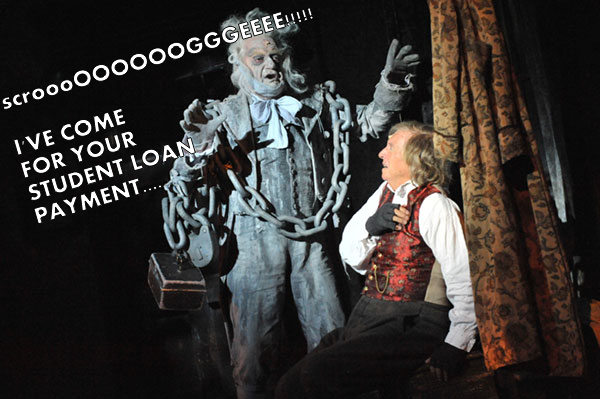
Whether it’s writing a check for your car payment or clicking ‘pay online’ for that student loan installment, carrying around debt can often times feel like you’re dragging along the undead chains of Jacob Marley.
That’s why I’ve already started the ball rolling in the past few months on what I want to take full-strength into the end of this year and the start of the next – paying it off. It’s possible to have a debt-free life. Oh, I know there will be bills to contend with, but debt is not the necessity that so many of us have been fooled into believing is necessary.
That whole idea that you need to spend some credit to get credit?
Nah-uh. I no longer buy into it. Why create more debt for yourself so that you can add to that debt or create new debt later?
I’m not preaching from on high on this. I’ve been saddled with debt for a very long time. I transferred around colleges a lot, including two years at a private school before going back to a state school. During that time, I frequently would get those student loan notices in the mail that would offer me the chance to make a payment then, but would read “$0.00 due.”
Well, the coffee shop barista/movie theatre projectionist who was working while in school and had expenses to pay for (apartment, food, gas, car payments, etc) chose to focus only on that “$0.00 due” and never gave a thought to the bigger picture. “Graduating college was a long time off, right? I’d get a great job and pay those off in no time when the time came.”
That’s what I told myself.
After college came some very low-paying jobs…and credit cards were added to the mix. I should have seen the warning signs early on that when I was relying on credit cards to get me through gas fill-ups on the car, among many other things, there was an issue. I didn’t see it, or chose to ignore it and I paid for it, with interest, later on.
Fortunately for me, it took about 3 1/2 years, but that credit card debt, all $10k+ of it was paid off in full several years ago. I can’t express what that felt like. It was like a boulder had been taken off my chest, and to know that I was able to pull that boulder off with some hard work and dedication, made it all the greater a feeling.
After that came paying off one of my four student loans, this one through Keybank. (Don’t you love how banks can sell/buy your debt around to each other, splitting off loans, adding to your monthly payments, as if you were an indentured servant? It’s scary.)
These days those ‘debt chains’ consist of the remaining three student loans and my car payment and I intend to pay them off as quickly as I can. It’s a lesson I learned but wish I hadn’t done so through “trial by fire.” I started an Investment Fund (with the intent to be used for education) for our little guy the minute I could, as did some relatives, contributing a little each month into investments that can be used for his education, should he choose to when he’s of age. It’s a head start for him, and it’s all in an effort to make sure he doesn’t repeat the same mistakes that I did.
So, I’m on the mission to pay this stuff off, sooner rather than later. Why am I telling you this and putting it out there to the blogosphere for all to see my financial shame?
Easy. The answer is – pressure.
Currently, how much I have to shell out every month and how much debt is still hanging over my head is known really only to me, my wife, and some of our family. I feel that by putting it out there, there is more pressure on myself to stick with it, to make it happen, or else I’ll have to admit to you and all the world on here that I failed, that I caved, that I didn’t see it through. And I see things through, even the not so great ideas.
I’ve read of something called the ‘Snowball Effect,’ where, once you pay one debt off, you take the money you were paying into it each month and throw it at another debt like wood into a fire. Disregard higher interest rates. You throw everything at the next lowest balance and pay the minimum on the rest. When it’s paid off, you take all that and throw it on top of the next one, etc, etc.
With that said, here’s where we stand (these are rough estimates):
National Education – $1,500
Car Payment – $6,800
Sallie Mae – $12,200
Discover/Citibank Student Loan – $23,000
So here’s the plan. I had been paying $75 on National Education every month. I’ve taken the money that went to Keybank ($150) and applying that to National Education EVERY PAYCHECK, on top of the monthly $75 I was making. So, that means I’ve gone from paying them $75 a month to $375 a month. By my estimation, that should have National Education paid off by the fall.
Once that is done, that $375 then gets tacked on to the $325 I already pay every month on my car, meaning I’ll be making $700 payments on my car each month. If I did the math right, that should wrap that up by the middle of winter.
Hopefully, you see where I’m going with this.
So, there you have it, interwebs. That’s my plan, and I would never share something that personal with the world if not for the need that by putting it out there, I feel the pressure to stick with it every month. It can be done, and it will be done.
But I will admit that I’ve given myself the clause that after National Ed and the Car are done, that I could use that $700 towards a mortgage if we’ve found a house in an area we like at that point. We’ve only been casually looking as we continue to fix up our own and try to find one we love, with room for our little guy to run around safely and possibly more kids down the line.
We’ll see, but there you have it. That’s my plan to unlock these chains.
Like many other families, this past year and a half or so has had its share of up and down moments, but we’ve been lucky enough to have many more ups than we have had downs.
Every time our little guy learns something new, makes a new expression, says a new word, or just enjoys something in a way he never did before (splashing in puddles, apple picking, or just being pushed around the room in a cardboard box) it has filled our hearts with memories we will always cherish. When I watch him playing with mommy or running around our house, or laughing it up with Gramma and Grampa, I smile thinking of just how much joy he is experiencing and how these are the moments to hold in our memories.
It’s recently saddened me to come to the realization that these times we will remember so fondly, he won’t.
As we start looking to the future and think about what other needs we may have someday as our family grows, new locations, new housing, is at the top of that list. While it’s not immediate, it’s certainly a someday, as our current place was great for Meg and I, but as our family grows, our tiny space seems to shrink more and more.
That got me thinking about the various places that I had lived growing up, equating our current situation/house/neighborhood to what I remembered of the early residence my family had when my brother was born and I was three years old.
Then it began to dawn on me. That was at three years old and that’s the earliest I can remember…well, anything, really. Unfortunately, even that memory is spotty, remembering more just vague images of the surroundings and area through the eyes of a child. I don’t remember my brother being born. I don’t remember the apartment we lived in before that period of three-years old.
Of course, that led me to the inevitable conclusion that all of these wonderful memories we’re making, all these moments of enjoyment our little man is having each day, reacting to, communicating with us…it’s very unlikely he’ll remember any of it. And it just saddened me.
While I didn’t know it at the time, it’s an actual form of development known as Childhood Amnesia.
According to scientists, childhood amnesia (or infantile amnesia) is the term for our inability as adults to recall memories before the stage of 2-4 years old. During our first one to two years of life, scientists say that parts of our brain known as the limbic system holds what is called the hippocampus and amygdala (used in the storing of our memory) and are not fully developed at that point in our growth.
Researchers have found that sometimes children can recall memories from before the ages of 3 or 4, but that’s something they can accomplish while they are still children, and an ability that declines as the children age. It can vary from child to child, reportedly, as to when they start remembering. Sometimes it’s 2 year old, sometimes 3 1/2, other times 5 years old.
Days spent with no reference of time, of limitations – purely of emotion and the drive to do, to play, to enjoy and to love.
It seems a bit unfair to me that these wonderful, carefree times should go unremembered by a child. At these early ages, we as adults get to enjoy in the purest form of their joy and yet, they will not be able to do so themselves.
However, an article just this year by the MinnPost on more recent studies show new insight into this whole phenomenon.
The researchers used 81 3-year-olds and their mothers who had volunteered in an earlier study on the development of memories in infants by the University of Minnesota’s Institute of Child Development.
As mother talked with their child about six events (ranging from neutral events to positive events) that the child had recently experienced and were recorded doing so, asked to talk to their child as they normally would in any other situation.
In the years that followed, the researchers then made contact with the families again and asked the kids (at different ages, ranging from 5 to 9) to recall the events they talked about with their mothers when they were three. The age differences were so that the researchers could take note of what varied in each child along with how much they either remembered or had forgotten.
According to the MinnPost article, they found that “children 5, 6 and 7 years of age remembered a substantial percentage of events from the age of 3 years. In contrast, children 8 to 9 years of age had lost access to many of their memories of events from the same early age.”
That finding suggested that age 7 was the “inflection point” for childhood amnesia.
While that in itself is not groundbreaking or new information, the recent study is reportedly the first to demonstrate the finding using the recollections of the children.
The study also found that those children who remembered more details of the events discussed at three years old had mothers who had encouraged the child to elaborate on the memories as well as let the child steer the course of the conversation. The researchers say that encourages the child to participate in the give-and-take of the conversation as well as fill their recollection of the memory with their own content.
The MinnPost article goes on to point out that the study revealed the paradox that children between 5 and 7 recalled 65-72 percent of the events they talked about with their mothers at the age of three, but those children who ere 8-9 years old could recall only 35 percent of the events.
And while the older children remembered less of the events, what they did remember was in more detail. The researchers also say those older children were able to take perspective on the events by giving more evaluative information about them.
What the researchers believe this all suggests is that narrative abilities play a role in what is remembered. After seven years old, the language skills of a child have become stronger, which allows them to create a more elaborate narrative for each memory. That then helps the memory become more firmly established in their minds. Whereas at the younger ages, they don’t have much knowledge of the why, what, where and when that goes along with those memories, leaving many of them to be forgotten.
One of the finest Christmas presents I’ve ever received in my adult life was a few years ago when my wife gave me my very own shaving kit that she assembled.
There were no cheap, disposable razors in here. No, no. In the set was a nice, chrome stand that held a badger-hair shaving brush (as hog hair, which are used in most of the shave brushes you find in general stores these days, is a bit too harsh), some shaving soaps to create a lather with the brush, and the piece de resistance – a safety razor.
Never has shaving felt like a finer ritual than with these tools at the ready on our bathroom sink.
I once read someone say something akin to “you haven’t shaved if you haven’t done so like your grandpa did back in the day” and boy, were they right.
I don’t shave every day as my current job doesn’t require me to like the last one did (and even then, I admit occasionally cheating at the office with an electric one at the last minute). I now shave when I feel that the stubble is getting a bit uncomfortable (usually twice a week or so) and when I do, it’s a great experience all thanks to this nice little, thoughtful and very timeless gift.
Creating a lather
Some hot water to the face gets the bristles ready and it’s really something to see the lather appear as you spin the brush around the bowl over the shaving soap. There’s all sorts of soaps out there, but my wife went the extra mile and found homemade shave soaps online made from natural materials as opposed to chemicals, which I truly appreciate. Lather it on with the brush generously, then keep that hot water flowing to run the razor under.
I really can’t say enough of just how zen a feeling it can be to stand in front of the mirror, gliding the hot blade of the safety razor across my cheek, wiping away that shave soap lather and the hair along with it.
Put some music on while you do so and you really have a ritual.
I will add, merely as a side note, that when I began shaving this way, it was with a blade made in Germany, versus the blade I’m currently using which was made in Japan. It could just happen to be this particular blade I’m using now, but I find myself getting a few nicks with this one. With the original blade made in Germany, I never got a single nick.
One day I’ll have to teach my little guy how to shave and when we do, I hope we’ll be doing so with these very same tools. There’s something timeless about them, as is knowing that you’re carrying on a method and tradition that has been around for generations prior.
Some people may scoff at the idea of a comic book making a profound emotional connection with someone. But, since you’re at a blog called “The Dorky Daddy,” I’m hoping you either know what you’re in for or are open to the possibility.
Feeling a craving for a bit of nostalgia from my teen years, I recently decided to re-read one of my all-time favorite comic book series, Starman.
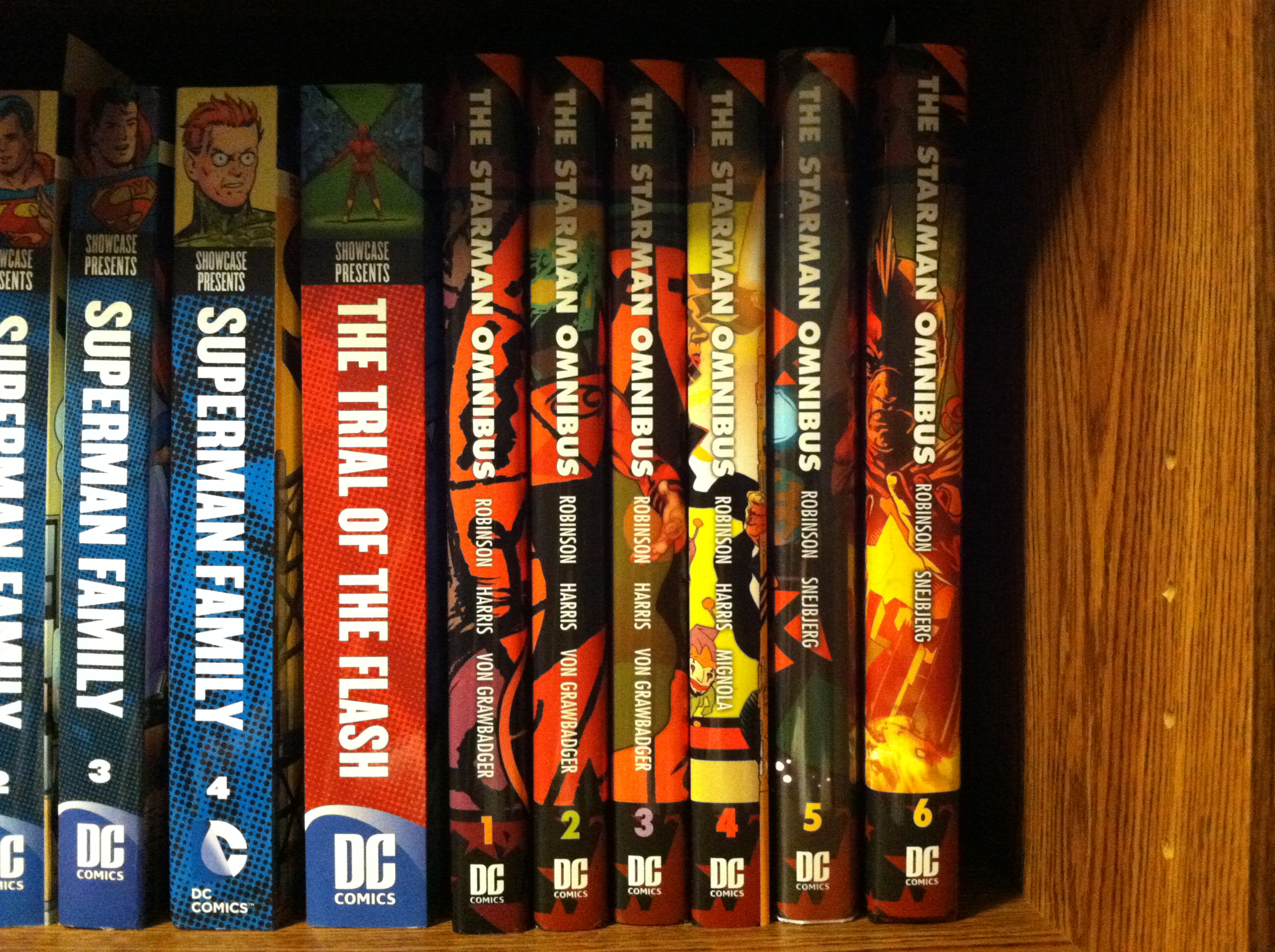
Published from 1994 to 2001, it now sits on my shelf in the form of a nice, six-volume hardcover collection. It was a wonderful comic book series that felt like no other at the time and honestly, since. It can always be tough to go back and re-read something you had so much affection for at a different stage in your life, so I wasn’t quite sure how this was going to hold up.
What I ended up discovering, though, is this epic saga not only held up, but there were layers upon layers of themes and emotions within that there was no way the teenage and college student version of me could have ever grasped or felt during its initial release the way I do now.
The thing that changed my entire perspective between reading it then and reading it now was becoming a father.
I remember really enjoying this series during its original run because of its keen writing and its bent on nostalgia. It was littered with references to old comics and characters and history-laden stories of the 1940s, 50s and 60s and was a delight for a fan of older comics like myself. Another theme of the series, perhaps – an appreciation for the past and the beauty in previous eras and the things, people, and cultures that came before us.
There were things then, though, that I had no way of appreciating. It was not until now that I feel such resonance for what it is at its core – it is a saga about fathers and sons.
Young Ted of the 40s and Older Ted of the present
You have Ted Knight, a scientist who used his brains and sense of good during a more naive age of America, becoming a costumed crime fighter. Out of costume, he worked on the atomic bomb during WWII, something that haunted him for the rest of his life and cost him several years in an institution. Now, (now as in, the 90s, when these stories were printed), Ted is old, gray and devoting his remaining years to science.
You have David, the eldest son who wants to make his father proud by putting on the silly costume and taking up the superhero mantle, despite his brother, Jack, mocking it the entire time. David fails at being a hero. More on that in a moment, but his failure leads us to…
Jack Knight, youngest brother, collector, stubborn, and disinterested in the silly costumes of his father and brother.
The gist of the series is that Jack, an antique dealer, reluctantly inherits the mantle of “Starman” – the superhero identity of his father’s from the 1940s. Jack doesn’t want to do it, but after his brother tries to and fails, fatally, Jack has no choice but to use his dad’s inventions (but not his gaudy costume) to save his father, friends and city from old and new evils.
Jack goes on an incredible journey over the course of those 80+ issues, collected in these volumes. He doesn’t want to be a hero. In fact, he thinks his dad was pretty ridiculous to be dressed in a gaudy costume and flying around using his scientific inventions to stop thieves and mad scientists, even for the 1940s and 1950s.
When the tales begin, eldest son David, as mentioned, is trying to make his father proud, while Jack points out just how silly super heroics and costumed crime fighters are. Like many families, they fight. They fight over stupid things.
Even super-heroes can have family issues.
And when David dies in that silly costume by the bullet of a sniper, Jack does not think, in some cliche way, ‘I must avenge my brother’s death’ or ‘I must carry on my father’s tradition.’
Heck, no. Jack thinks he’s gotta get outta dodge.
However, it turns out it was no random act that his brother died, but old villains from yesteryear, now old themselves, taking out revenge on Jack’s dad and the family for years of those bygone ‘good vs evil battles’ when good always triumphed.
Jack picks up the mantle reluctantly, out of protection for his father more than anything else, but in doing so, inadvertently begins his own path down the road to hero. There’s no secret identity here. Jack makes no bones that it was him when people see a man taking to the skies again with his father’s inventions. But he doesn’t relish it either. No, Jack tells his dad he’ll do it for a little while, then be done. He just wants his normal life with his antique store.
How many of us say we’ll do something ‘just for a bit’ only to find ourselves doing it for years?
In time, Jack’s relationship with his father not only heals from the constantly-fighting father and son they began as, but grows into a man who starts to appreciate all his father had done with his life, and all he did for his family.
It develops into a relationship that can only come as one ages, one matures, and one sees through his own eyes what a father must do for his son(s). It’s in no way cliched and moves organically, naturally, a progression of maturity and spirit in the character of Jack that you feel along with him through each subsequent chapter.
The wholesome adventures of the ’40s turned out to not always be so wholesome.
Jack even learns of the mistakes his father made along the way (an affair with the attractive super heroine Black Canary, for one). What this does for Jack is paint his father out to be more than an old man, more than the foil of his angst-ridden years. He learns his father is a human being, like he.
In time, Jack, a man who once went through relationships fast and loose, becomes so smitten in love with a woman that he is willing to head off into space (a scary prospect to think about realistically) for her in an attempt to find her long-lost brother, a forgotten super-hero from the 1980s.
At one point in his hero’s journey he is captured, drugged, and raped by the daughter of one of his dad’s old enemies.
A year later, Jack receives a letter from her telling him her intention was to become pregnant, and it worked, adding that she has borne a son and will raise him to hate his father and want to kill him.
How heart-wrenching.
As Jack’s eyes swelled with tears reading the letter and telling his father the news, my heart broke for him in ways it never could have when I read this as a teen.
In a medium like comic books, when you picture people like Batman battling the Joker or Superman engaging in a battle of wits with Lex Luthor, this type of villainous plan – getting pregnant and raising the child to hate the father – is quite possibly the most diabolical.
More diabolical than any world conqueror or killer clown.
Wow. Just wow. Talk about what an emotional punch to the gut that is for a man to think about.
By the saga’s end, the villainess is no more and Jack finally gets to see and hold his own son. Unfortunately, though, it is not before losing his own father. Ted, the former superhero, now old and dying, gives up his own life to save the city and people he had protected for decades, even paying his old arch-enemy, a man who hated him for decades and orchestrated a bomb that’s about to go off beneath them, a little bit of respect.
Ted Knight – a gentleman hero, right to the end. An explosion soon follows this page.
It’s soon afterward that Jack finds the love of his life has gone, and without his love, his brother, or his father, he is truly alone in the world to raise his young son.
Following Jack from beginning to end on this journey from snarky punk to savior, son and father – you’ll want to weep right there with him as he falls onto the floor of his antique store, everything in his world gone, wailing alongside his infant child. I did.
A funeral for his father is touching, with old men and women who were once young, popular heroes of comic adventures during World War II giving eulogies about the man who shed his red and green super hero costume but still became a hero to the world.
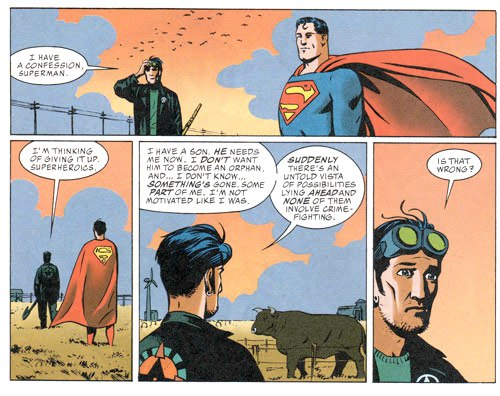
Not long after the funeral, Jack decides that being a father is the most important thing in the world to him and super-heroics just doesn’t have a place in that life. So, handing over the inventions of his father to a young heroine acquaintance, Jack sets out to start a new life, as a former hero to many, but primarily a hero to his son, not as a man fighting crime or super-villains, but by simply being there and being a father.
Not at all, Jack. Not at all.
What a ride and what a read.
Teenage me sort of got the ‘father and sons’ angle, but it was on the surface. My younger self could never have connected to and grasped the type of emotions touched upon here. As time went on, as I aged, as my parents aged, as I became a parent myself, all of this has given me a new-found set of eyes as I read through these pages once more.
I often find myself growing tired of comics the older I get, at least the new ones. I either pick up something new that in its own way has the feel of something older, or I just return to my bookshelf and the books I’ve enjoyed enough to keep in a collected edition in the hopes of reading and getting those old feelings of excitement again.
Starman is one of those books in spades. Writer James Robinson has woven a masterpiece of epic proportions across multiple fronts – superhero, nostalgia, and most of all, family. It is one of those books that I know I can always pull off the shelf when I want something to read that’s adventurous, funny, and best of all, full of heart.
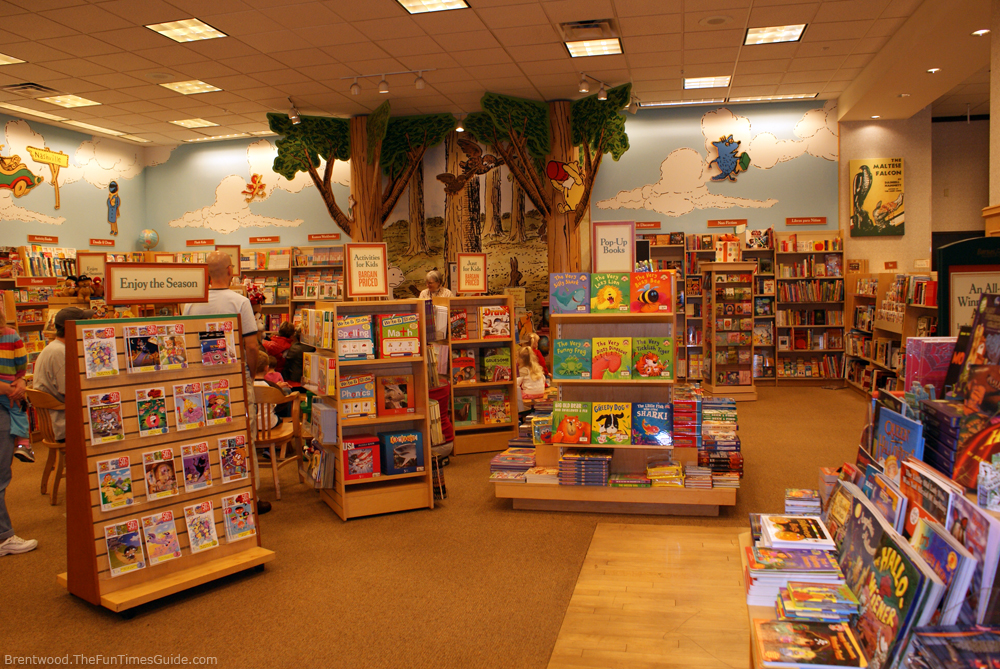
From our last adventure of father-son bonding with dinner at Uno, the little monkey and I then headed to Barnes and Noble.
The image in my head before we got there was of me sipping a coffee, while pushing him in the stroller, looking at children’s books and generally enjoying a calm night of books and bonding.
Yeah, no.
When we got out of the car, I realized that I had become so used to pulling the stroller out…of my wife’s car. You know, the car that was with her at the theatre. So, no stroller. Okay, no problem. We’d walk it. But that also meant I couldn’t take his big ol’ bag with me since there was no stroller to put it or him in. So, I took out a diaper and a wipe and shoved them in my coat pocket, just in case.
Heading into the store, we ran into a newspaper reporter I know from my newspaper days and we were chatting for a few moments about a recent article he had written and some slack he was getting from the public about it. It was an interesting conversation, but one that was abruptly cut short, as my little guy’s eye caught some children playing with Nooks in the Nook area of the store and pushed himself off of me, to the ground, and sped over to them as fast as his little feet could take him.
He just loves other little kids. His hand flailing in a non stop wave, he kept smiling ear to ear and saying “Hi! Hi!” in that tiny little voice to this little boy and little girl. Their dad, a hipster-looking guy with beard and a knit cap told me the little boy was just a week younger than our guy. It really made me realize how big our guy is. He was born big (10 pounds, 2 ounces), but I really saw it when he was standing there with a kid just around his age who was so much smaller than he.
Then, my son just opened his arms and hugged this other little boy. It was adorable. Absolutely adorable. But then, he wouldn’t stop. This other little boy would move back and here my son would go, arms out, like a cute little Frankenstein’s Monster, ready to embrace once more. I could see the look of fear on the other child’s face and tried telling my son that we should hold off on more hugs and look around some more. The dad was very nice, saying ‘hey, man, hugs make the world go round,” but I don’t think that did anything for that other little kid’s anxiety, or mine as the father of the kid accosting him.
The little girl, slightly older got a hug from my little man as well, and she just so happened to be wearing a Wonder Woman t-shirt. Well that did it for our guy. He kept pointing at Wonder Woman and all over this little girl’s shirt. She was very nice about it, but again, it’s hard to tell when you have little kids, where the line is being crossed from friendliness and cute to overbearing and assault.
I have to admit, I was sort of surprised when Hipster-Dad saw my son falling in love with the little girl’s Wonder Woman t-shirt and said ‘I take it he’s got a sister, huh?”
I explained that no, our guy just likes Wonder Woman. He’s got a Fisher Price Wonder Woman toy and Invisible Jet, along with some other DC Super Friends. Is that weird that I was so caught off guard by that question? If anything, I would have expected a hipster-dad to get the whole no gender slanting of toys thing. Odd, or maybe I’m just off. Who knows.
With a little prodding, I finally got my son to move down an aisle, but it turned out to be an aisle that was journals and non-fiction books, not to his liking. He started out well, holding my hand, but the minute he realized his place in the store and the destination of the children’s section, he took off, with me chasing him between aisles as he shouted ‘no no no no no!’ when I’d ask him to come back to daddy.
Boy, did I feel like a terrible father.
We got to the children’s section and started looking at books. He found old friends Elephant and Piggie, Daniel Tiger, and some new things that caught his eye. But then, he spotted the staple of the kids section at Barnes and Noble – the Thomas the Tank Engine play-set table. Only this time, unlike past visits, there were other children there using it.
Now, I’m sure we all idealize how our children will act, behave, etc and it’s probably always the same. They’ll calmly walk over and say hi to another child, find something no one else is using, and all will get along swimmingly.
I can fool myself for only so long.
He ran over, and immediately started playing with a train car that was part of the train another child was using. And when I walked over and stopped him, was met with a big ‘no no no no no!’ – his favorite new reaction. The father of these children was kind, much like Hipster-Dad up front, and said they were wrapping up anyway and that ‘we’ve all been there.’ The kids left and my little man played for a bit, but with no children around, he lost interest rather quickly.
He let out more energy with a one man show on the stage area of the children’s room, dancing for anybody who came by before heading to a corner to look at Sesame Street books. The night was getting on, and I could see him getting a little tired. I was proud of the fact that we were wrapping up without having bought a single thing. I didn’t want him to come to think of solo time out with daddy as a time to get/buy something. I scooped him up and brought him to the car where we had a pretty calm ride home to the tune of some classical music.
I was feeling like a daddy-failure. I was tired, but you know what? It turned out, he was pretty tired too. And for the first time since Meg rejoined the theatre, he actually fell asleep for me. I read to him, put him to bed and he fell asleep!
Now THAT, that felt like a success, if even a small one. 🙂



 Books by Mo Willems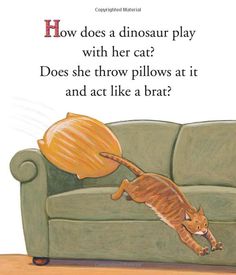










 The Dorky Daddy